Sewage Cleanup in Garland, TX
A sewage backup can turn a bathroom, laundry room, or garage into a health hazard in minutes. For sewage cleanup in Garland, call any time, day or night, and we will connect you with an available local cleanup company. Below you will also find what to do while you wait, who is responsible for your sewer line, and how insurance usually treats a backup.

Cat. 3
Sewage water class
24/7
Call line
One call
Tell us your ZIP code and what happened. Your call is routed to a cleanup provider that covers your area.
You decide
The provider explains price and timing. You are free to hire them or keep looking.
Independent providers
Providers are separate businesses. Confirm licensing, insurance, and a written estimate before work starts.
Garland Sewage Cleanup is a referral service, not a cleanup contractor. Calls to our number are connected to independent, third-party service providers who set their own prices and schedules. We do not perform any cleanup work ourselves.
Why sewage is treated as a biohazard
Not all water damage is the same. The cleanup standard used across the restoration industry, IICRC S500, sorts water into three categories. Sewage is always Category 3, the most contaminated.
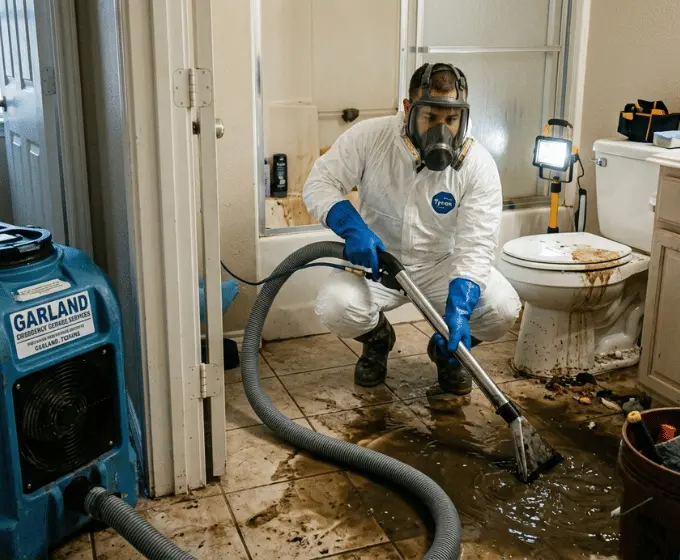
Sewage carries bacteria such as E. coli and Salmonella, viruses such as hepatitis A and norovirus, and parasites. It soaks into carpet pad, the bottom few inches of drywall, baseboards, and insulation, and those materials cannot be reliably disinfected once saturated. That is why a proper sewage backup cleanup removes them instead of just wiping the floor.
Time matters too. Clean water from a broken pipe can turn into Category 3 water if it sits for a couple of days or mixes with dirt and debris. The longer any water stays, the more likely mold becomes. The EPA recommends drying wet materials within 24 to 48 hours.
In Garland, many backups trace back to the private sewer line between the house and the city main. Tree roots, grease buildup, and older clay or cast iron pipe are common causes, and heavy North Texas storms can push extra water into the system. Read more on Category 3 black water cleanup.
| Category | Typical sources | What cleanup usually involves |
|---|---|---|
| Category 1: Clean water | Broken supply line, sink or tub overflow from a clean source | Extraction and drying |
| Category 2: Gray water | Washing machine or dishwasher discharge, toilet overflow with urine only | Extraction, cleaning, antimicrobial treatment, drying |
| Category 3: Black water | Sewer line backup, toilet overflow with feces, floodwater from outside | Containment, removal of soaked porous materials, disinfection, drying, and proper disposal |
Warning signs of a sewer line problem
- Toilets, tubs, or floor drains gurgling when other fixtures run
- Water coming up in the shower or tub when you flush
- Several drains slowing down at the same time
- A sewage or rotten-egg smell near drains or the lowest floor
- Dark water pooling around a floor drain or cleanout
- Wet spots in the yard above the sewer line
What to do in the first 30 minutes of a sewage backup
These steps protect your family and your insurance claim while you wait for help.
- 1
Stop using water
No flushing, showers, laundry, or dishwasher. Every gallon that goes down a drain can come back up at the lowest fixture in the house.
- 2
Keep people and pets out
Children, older adults, pregnant family members, and anyone with a weakened immune system should stay well away from the area.
- 3
Watch for electrical risk
If water is near outlets, cords, or the breaker panel, do not walk through it. Only switch off a breaker if you can reach the panel from a dry spot.
- 4
Ventilate if it is safe
Open windows and doors to the outside. Consider turning off the HVAC system so it does not pull odor and contaminated air through the ducts.
- 5
Do not mix cleaning products
Bleach combined with ammonia or acidic cleaners releases toxic gas. Skip household scrubbing on soaked carpet or drywall; it spreads contamination.
- 6
Document everything
Take photos and video of the water, the fixture it came from, and damaged belongings before anything is moved. Your insurer will ask for them.
- 7
Check whether it is the city main
If neighbors have backups too or a manhole is overflowing, report it to the City of Garland water and wastewater department. Their official page is linked in the next section.
Your sewer line or the city's? Who handles what in Garland
Knowing where the blockage is tells you who to call and who pays for the repair.
Every home in Garland drains through a private service line, often called a lateral, that runs to the public sewer main. As a general rule the property owner is responsible for the private line and the city maintains the main. The exact dividing point can vary, so confirm with the City before paying for work near the street.
The City of Garland requires a permit for sewer line repairs. Rental properties must use a state-licensed master plumber registered with the City. Owners who live in and homestead their home may qualify to do the work themselves under a homeowner's affidavit.
Keep in mind that a plumber and a cleanup company do different jobs. The plumber stops the backup by clearing or fixing the pipe. The cleanup company deals with the sewage that already came inside. Most backups need both, plumber first.
Official City of Garland resources
Report a water or wastewater issue (garlandtx.gov)Sewer repair permit rules (garlandtx.gov)| What you notice | Likely source | Who to call |
|---|---|---|
| Only your home is affected | Your private service line | A plumber to clear or repair the line, then a cleanup company |
| Backups started after heavy water use or you have large trees over the line | Your private service line (roots, grease, or a sag) | A plumber with a camera inspection |
| Several homes on the street have backups | The public sewer main | City of Garland Water and Wastewater (report on garlandtx.gov) |
| A manhole or street cleanout is overflowing | The public sewer main | City of Garland Water and Wastewater (report on garlandtx.gov) |
Biohazard cleanup in Garland
Some of the hardest calls have nothing to do with plumbing. Our line can also connect you with providers who handle these situations with discretion.
Unattended death cleanup
When someone passes away and is not found for days, bodily fluids and odor reach flooring, subfloor, and furniture. Families should not be expected to handle this themselves.
Read the guideCrime and trauma scenes
Blood and tissue after an assault, suicide, or accident. In Texas, eligible crime victims may be able to get help with cleanup costs through the Attorney General’s Crime Victims’ Compensation program.
Read the guideHoarding cleanup
Homes where clutter hides animal waste, rotting food, or sewage from failed plumbing. The work usually combines removal, sanitizing, and odor treatment.
Read the guideBlood and bodily fluids
Blood, urine, feces, or vomit on carpet, mattresses, and hard surfaces. Proper cleanup follows bloodborne pathogen precautions rather than household cleaning.
Read the guideSome homeowners and landlord policies cover trauma or biohazard cleanup, so it is worth calling your insurer. If a death or crime is involved, wait until police or the medical examiner release the property before any cleanup begins.
Will insurance pay for sewage cleanup?
It depends on how the water got in and what is on your policy.
Standard homeowners policies commonly exclude water that backs up through sewers or drains. Coverage usually comes from a separate water backup endorsement, which many owners never added. Check your declarations page or call your agent the same day. Photograph the damage and list damaged items before they are thrown out. More detail is in our guide on sewage backup insurance in Texas.
| Situation | Usually covered by |
|---|---|
| Sewage backs up through a floor drain, toilet, or tub | A water backup endorsement, if your policy has one |
| A pipe inside the home bursts suddenly | Standard homeowners policy in most cases |
| Rain or creek water flows into the house | Flood insurance (NFIP or private), not a standard policy |
| A slow leak or failing pipe over months | Often excluded as wear or lack of maintenance |
General information only. Policies differ, so your own policy wording decides what is covered.
What affects the price of sewage cleanup
Every job is quoted on site. These are the factors that move the number.
| Factor | Why it matters |
|---|---|
| Water category | Category 3 sewage needs containment, protective gear, and regulated disposal. |
| Size of the affected area | More square footage and more rooms means more labor and equipment. |
| Materials involved | Soaked carpet, pad, drywall, and insulation usually have to be removed. |
| Time before cleanup | The longer sewage sits, the deeper it wicks and the more likely mold becomes. |
| Access | Crawl spaces, tight bathrooms, and second floors take longer to work in. |
| Repairs afterward | Rebuilding drywall, trim, and flooring is often quoted separately. |
Ask for a written estimate before any work starts, and ask whether it covers cleanup only or cleanup plus repairs.
What happens when you call
- 1
You call
The line is open 24 hours a day, including weekends and holidays.
- 2
Share the basics
Your ZIP code and what happened, such as a sewage backup or a biohazard situation.
- 3
Get connected
Your call goes to an independent cleanup provider that serves your area.
- 4
You decide
The provider explains price and timing. There is no obligation to hire them.
Questions to ask any cleanup company
Whoever you hire, these answers tell you a lot about the quality of the work.
- Do your technicians hold IICRC certifications for water damage (WRT) and microbial remediation (AMRT)?
- Do you carry general liability insurance, and can you send proof?
- Will I get a written estimate before work starts?
- How do you handle carpet, pad, and drywall that sewage touched?
- Where do contaminated materials get disposed of?
- Will you provide photos and moisture readings for my insurance claim?
Sewage and contamination cleanup in Garland
Guides to the most common cleanup jobs in Garland homes and businesses, starting with sewage backups. Each page explains the warning signs, the health risks, and what a proper cleanup should include.
Sewage Backup Cleanup
Removal of raw sewage from bathrooms, laundry rooms, and floors, followed by disinfection and drying.
Black Water Cleanup
Cleanup for grossly contaminated water such as sewage, toilet overflows with waste, and outside floodwater.
Unattended Death Cleanup
Removal of bodily fluids, contaminated materials, and odor after a death that went undiscovered for days.
Crime Scene Cleanup
Cleanup of blood and other biological material after a crime, suicide, or serious accident.
Hoarding Cleanup
Clearing and sanitizing homes where clutter hides animal waste, spoiled food, sewage, or pests.
Blood & Bodily Fluid Cleanup
Cleanup of blood, urine, feces, or vomit from carpet, mattresses, and hard surfaces.
Odor Removal
Finding and removing the source of lingering sewage odor after a backup, then deodorizing the space.
Water Damage Restoration
Extraction and structural drying after leaks, with guidance on when clean water turns into a contamination problem.
Storm & Flood Cleanup
Cleanup after rain or creek water enters a home, which is treated as contaminated water.
Mold Remediation
How mold grows after water and sewage losses, and what proper remediation involves.
Drain Cleaning
How to tell a single clogged drain from a main line problem, and what to do if sewage gets inside.
Sewage cleanup across Garland and nearby cities
Garland is a city of about 246,000 people with a lot of homes built from the 1950s through the 1980s, which is the age range where original sewer lines start to crack, sag, and collect roots.
Garland ZIP codes
Neighborhoods
Downtown Garland, Firewheel, Duck Creek, Club Hill, Oakridge, Camelot, Lake Ray Hubbard shoreline, South Garland near I-635.
Sewage backup questions from Garland homeowners
If sewage is still coming up, a plumber needs to clear or repair the line so the flow stops. A cleanup company then removes the contamination, disinfects, and dries the area. If several homes on your street are affected or a manhole is overflowing, the problem may be the city main, so report it to the City of Garland water and wastewater department through garlandtx.gov.
Yes. Raw sewage is classified as Category 3 or "black water" under the IICRC S500 water damage standard. It can carry bacteria such as E. coli and Salmonella, viruses such as hepatitis A and norovirus, and parasites. Anything it soaks into should be treated as contaminated.
A small overflow on a hard, non-porous floor like tile can sometimes be handled with gloves, eye protection, and a proper disinfectant. Once sewage reaches carpet, drywall, baseboards, or subfloor, professional cleanup is the safer choice because those materials hold contamination that surface cleaning cannot reach.
Usually only if your policy includes a water backup or sewer backup endorsement. Standard homeowners policies commonly exclude water that backs up through drains or sewers. Check your declarations page or call your agent, and take photos before anything is removed.
Removal and disinfection of a typical residential backup often takes one to three days. Drying can add several more days depending on how far the water spread and what materials it reached. Repairs to drywall and flooring are a separate step after that.
No. Garland Sewage Cleanup is a referral service. When you call, you are connected with an independent local cleanup provider. That provider sets the price and schedule, and you decide whether to hire them.
Dealing with a sewage backup in Garland?
Call our 24/7 line and we will connect you with an available local cleanup provider. Ask them about pricing, timing, and insurance before any work starts.
Garland Sewage Cleanup is a referral service, not a cleanup contractor.